

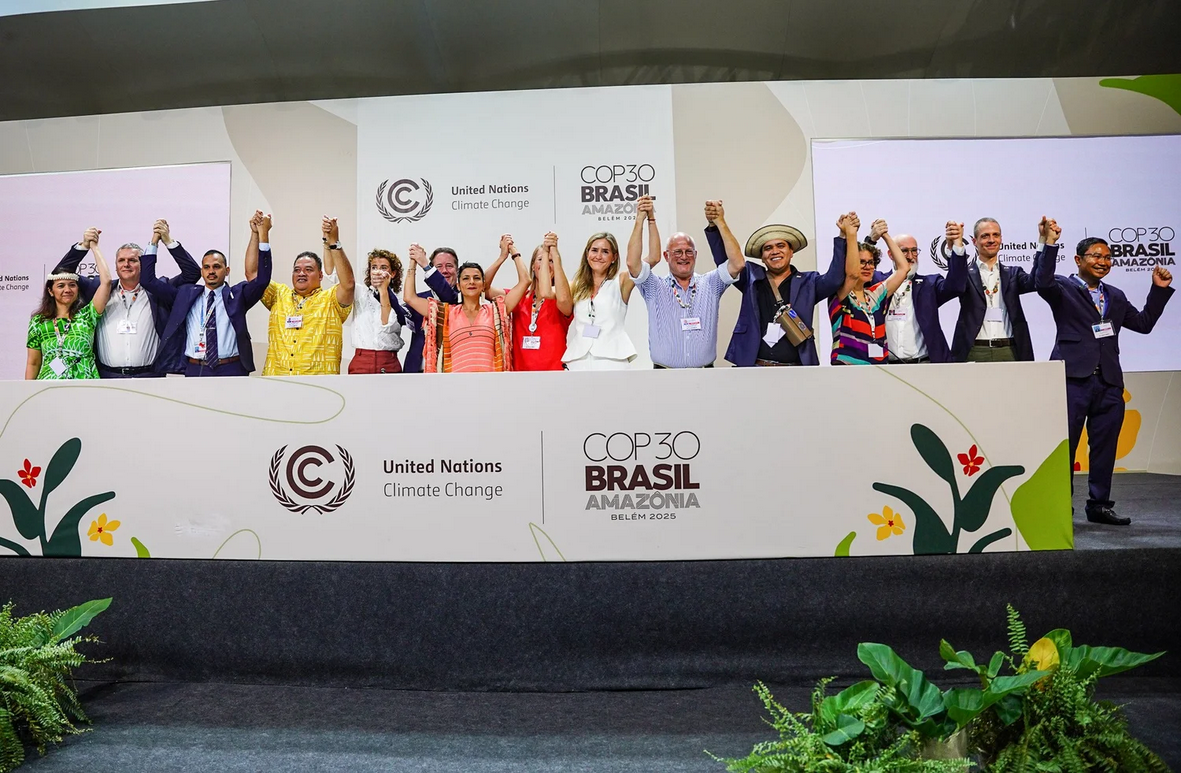
In the past months, Seed the Commons has participated in the People’s Summit Towards COP30, co-organized a solidarity march in San Francisco, and hosted a post-COP30 webinar series. In all these efforts, we have raised awareness of the connections between colonization in the Americas and climate change, notably through cattle grazing.
The wars that the US and Israel are waging in West Asia are part and parcel of the same expansionist, colonial system. Climate change and imperial wars go hand in hand. Reclaiming food systems from corporate control is vital because it is a step in divesting from an economy based on war and imperialism. It is about growing another system, one that is just, sustainable, life-loving and life-giving, literally from the ground up. The current rise in synthetic fertilizer prices has further highlighted the importance of removing fossil fuels from agriculture, both for our resilience and sovereignty, and to unlink ourselves from wars waged for oil.
On November 15, a Seed the Commons’ delegation marched in Belém alongside thousands of activists from around the world calling for real solutions to climate change. We also co-organized the Global Day of Action for Climate Justice march in San Francisco, along with the SF Labor Union, SEIU Local 1021, and several other organizations. On that same day, activists in San Francisco marched in solidarity with activists from the Global South, amplifying their demand for real solutions. A Seed the Commons banner advocating for a transition to veganic farming for true regeneration from North to South was carried through both cities.
At the San Francisco march, Martha Hawthorne, a member leader from SEIU Local 1021 relayed a message that our co-founder Chema Hernández Gil sent from COP30, calling for a transition away from industrial and animal agriculture and the need for people-led solutions to climate change. Martha also spoke about Gaza and extreme wealth inequality. All of this is connected, and urgent.
As the US and Israel drop bombs on Iran and Lebanon, we will continue to make these connections. We renew our commitment to move away an economy based on extractivism and colonial expansion, and to work for a transition away from fossil fuels. It is time to bring together the anti-war and climate movements, and to plant the seeds of a food system that does not feed into imperialist wars.
For the past two months, we have been engaged in a process that culminates this week in the First Conference on Transitioning Away from Fossil Fuels, to be held in Santa Marta, Colombia. This conference is hosted by the governments of Colombia and the Netherlands as a complement to the COP to deliver implementation-driven action to address climate change.
As the first step, the conference organizers invited stakeholders to provide written submissions to a number of questions around fossil fuel phaseout. We have copied our complete submission at the end of this post. Our contribution has already been impactful in that it helped shape the draft of the Civil Society Organization Sector position paper for the conference. This draft paper explicitly recognizes our message that industrial food systems are structurally fossil-fuel dependent and major drivers of methane and deforestation, with the inclusion of methane already a significant achievement. The draft specifically names livestock production as the largest anthropogenic source of methane that must be integrated into transition frameworks, while directly calling out livestock-based “regenerative” models as a false solution.
Furthermore, our proposed interventions have been elevated to a “Cross-cutting Systemic Solution” across the document. It embeds our call for the immediate divestment of public funds from fossil-fuel-reliant animal agriculture to redirect them toward localized, biodiverse food systems. The draft even champions a global shift toward plant-based diets to free up vast territories of land for rewilding and ecosystem restoration. We are thrilled that our targeted input successfully made agriculture a central pillar in the global civil society strategy for a just transition.
Our original intent was to only participate in the two-month online process, but we became increasingly encouraged by the experience and ultimately decided to also attend this historic conference in person so as to do as much as possible to help strengthen and shape this process. We hope that this conference achieves its goal of contributing to the COP30 Presidency’s roadmap and helps us move toward the phaseout of fossil fuels, and we will work to ensure that due focus is given to the role of food systems in this process.
For updates, follow us on Mastodon, Instagram, X, Facebook, and sign up for our newsletter.
To support our work, please donate here.
Seed the Commons’ Official Submission to the First Conference on Transitioning Away from Fossil Fuels

Q1: Barriers and Instruments

Agricultural Blind Spot and Failure of COP: The global approach to emissions has been fragmented, as highlighted by the exclusion of industrial and animal agriculture from climate negotiations. Focusing solely on energy systems while ignoring other major fossil fuel-dependent sectors impedes the creation of an effective transition framework. Conventional agriculture relies on fossil fuels, from synthetic inputs to supply chain logistics, as does much of organic agriculture through its use of animal inputs from conventional farming. Even ecological animal husbandry falls significantly short of animal-free ecofarming in terms of emissions reduction and land efficiency.

Methane, Deforestation, False Solutions: Methane is the second most significant greenhouse gas, driving over 0.5°C of observed warming. Livestock is the single largest anthropogenic source of methane, emitting 109 million metric tons annually. Furthermore, grazing is a primary driver of global deforestation. The impact is twofold: deforestation releases carbon into the atmosphere and also destroys our most vital carbon sinks. International frameworks legitimize “false solutions” which fail to address the root causes of emissions and food system unsustainability, like corporate takeover of food systems. “Regenerative grazing” has gained some acceptance within environmental NGOs, but it is another false solution. Grazing, even when labeled regenerative, has a destructive effect on ecosystems. Truly regenerative agriculture does not involve livestock.

The Supply-Side Gap: Without a legally binding instrument that comprehensively addresses both fossil fuel extraction and the industries that structurally depend on it, continued expansion of these industries will lock in emissions. We lack a framework to coordinate an equitable phase-out that redirects financial flows away from extractive industries and towards localized food systems centered on fossil fuel-independent agriculture. [Pillars 1, 2 & 3]

Q2: Solutions

Solution 1: A Fossil Fuel Treaty (Expanded Scope)
Thematic Pillar: Pillar 3: Strengthening international cooperation and climate diplomacy
Subtheme: Addressing implementation, cooperation, and governance gaps, including the scope and challenges of the UNFCCC (Pillar 3)
Level: Global
Description: A Fossil Fuel Treaty must establish legally binding conditions to coordinate an equitable phase-out of fossil fuel production. The scope of this Treaty must be expanded to comprehensively address all systemic drivers of emissions, including methane. Because the global livestock industry is the largest human-caused source of methane and relies heavily on fossil fuel inputs, a credible Treaty cannot ignore animal agriculture. Furthermore, we reject loophole language—such as the Belém Declaration's commitment to phase out only "inefficient" fossil fuel subsidies—as this is designed to justify continued extraction. The Treaty must redirect all such subsidies to fund a just transition for dependent nations, workers, and local food systems.

Solution 2: Redirecting Subsidies and Cultivating Localized, Biodiverse Food Systems
Thematic Pillar: Pillar 2: Transforming fossil fuel supply and demand
Subtheme: Closure of new demand drivers
Level: National / Sub-national
Description: Governments heavily subsidize animal agriculture that is fossil fuel intensive, high in greenhouse gas emissions and destructive of native ecosystems, stifling sustainable alternatives. A concrete solution is the immediate divestment of public funds from animal agriculture and fossil-fuel-reliant agriculture, redirecting them to support sustainable farming, including youth-oriented initiatives. We must provide financial and technical support to transition to locally grown diets and animal-free ecofarming. This should include efforts to support a consumer shift towards more sustainable foods, including through a sociocultural emphasis on promoting local plant-based staples, framing this as a mechanism to uplift local producers, foster climate-friendly consumption, and protect and re-value local culture, knowledge and biodiversity.

Solution 3: Reclaiming Territory for Rewilding and Ecosystem Restoration
Thematic Pillar: Pillar 1: Reducing economic dependence on fossil fuels
Level: Global / National
Description: To achieve a 1.5°C pathway, we must drastically reduce the fossil fuel reliance and immense land footprint of global agriculture. Transitioning away from animal husbandry frees up vast territories of land. Some of this  land must be reclaimed for ecosystem restoration, afforestation, and rewilding—which are the carbon dioxide removal methods with the largest sequestration potential in the shortest timescale. Vital for protecting the Amazon this also applies to diverse global ecosystems, where we must prioritize the restoration of healthy soils and microbiology for carbon capture. Returning land to forests and other ecosystems is a climate necessity. By moving toward animal-free ecofarming models, we can create dignified livelihoods in sustainable farming, ecological management and restoration, and ensure rural communities thrive while achieving negative net emissions.